

Is sustainable lime production the missing piece of the CDR puzzle? CarbonBlue’s head of MRV, Dr. Josh Steinberg, explains why it may be the key to unleashing a new industry boom, and enabling unprecedented CDR upscaling.
The CDR industry is, first and foremost, an industry concerned with chemistry. It’s there in the name: “Carbon Dioxide Removal” literally describes a chemical process. To understand what’s holding the CDR industry back, and to grasp what it’ll take to scale it up to the capacities needed to meet the IPCC’s climate goals, we first need to understand the chemical property which lies at its heart: Alkalinity.
What is Alkalinity?
Alkalinity is the term we use to describe the ability of a liquid solution to “counter” acids. Acids are chemical substances that are able to “donate” protons (hydrogen ions, H⁺) to materials which they come into contact with, and alkalinity is a property of liquid solutions which can accept the acid’s proton donation. This process is called “countering,” and can take place thanks to the cocktail of ions and protons belonging to the materials dissolved in the liquid. When an acid is countered, its ability to react with other materials is diminished.
In short, an “alkaline material” is a material that, when dissolved in liquid, boosts that liquid’s ability to counter acids if they are introduced to the solution.
In the context of climate change, arguably the most important acid is CO2, because when it is present in the atmosphere, it contributes to the greenhouse effect which is heating up our planet. If we counter CO2, then it is consequently removed from the atmosphere.
Alkalinity is Central to CDR Technologies – and Difficult to Produce
Many CDR technologies rely on alkaline materials to capture CO₂ from the environment. By exposing alkaline materials to CO2 in just the right way, it’s possible to create a chemical reaction in which the CO2 is “bound” to the alkaline material. This durably sequesters the CO2, meaning that it is locked in place in a chemically stable form which keeps it from returning to the atmosphere, where it would otherwise continue to act as a harmful greenhouse gas.
But therein lies the problem: while alkaline materials are very common, and used in countless industrial processes and products, the production of the alkaline material which is most effective for CDR, lime, currently emits more CO2 than that lime can then capture downstream.
Traditional Lime Production
Lime is a substance that has been produced using broadly the same method since prehistoric times. Used in countless industries, lime is an essential material in almost every human activity, from construction and industrial manufacturing, through agriculture, to food and materials production.
The conventional method to produce lime is to heat limestone in a kiln at high temperatures (1000°C), which require the combustion of fossil fuels. This breaks the limestone (CaCO3) down into CaO (calcium oxide; aka quicklime) and CO2. These inevitable CO2 “process emissions” released from the limestone, account for 60-70% of the total emissions of lime kilns, that currently accounts for ~8% of global CO₂ emissions. In addition, the combustion of fossil fuels releases CO2 as well. Because of this, even if the industry switched to entirely renewable, clean energy, roughly two-thirds of the carbon footprint would remain, leaving lime production “hard-to-abate”.
Recarbonation – the Heart of CDR
One of the great ironies of the lime emissions problem is that the resulting lime has a strong chemical “desire” to bond with carbon dioxide, a reversal process called recarbonation. When this happens, the lime gradually reabsorbs CO₂ and reverts to solid calcium carbonate (rock), a thermodynamically stable form of CO₂ storage. While this carbonation happens naturally over years or decades in materials like lime mortar, it can be artificially accelerated for environmental benefit. By turning lime into an intentional CO₂ removal tool, it can help us decarbonize a hard to abate industry and in time, meet climate goals.
The EcoLime Solution: Creating Green Lime
The key to transforming lime from a climate problem into a climate solution lies in disrupting its production cycle and developing a “green lime” production method as an alternative. CarbonBlue’s proprietary technology, EcoLime, does just that. By targeting both sources of emissions – combustion emissions as well as emissions from the chemical process – we are able to reap the environmental benefits of lime as a ubiquitous, reactive, alkaline substance, while sidestepping the environmental “cost.” inherited with its production.
From Passive Uptake to Active Carbon Removal (CDR)
Once we have a sustainable source of lime, it can unleash a whole new generation of CDR solutions. Sustainably produced lime could make CDR technologies much cheaper, and much easier to scale up. Let’s take a look at some of the prevailing CDR solutions employed today, and how EcoLime can be integrated into their core processes.
Direct Air Capture (DAC)
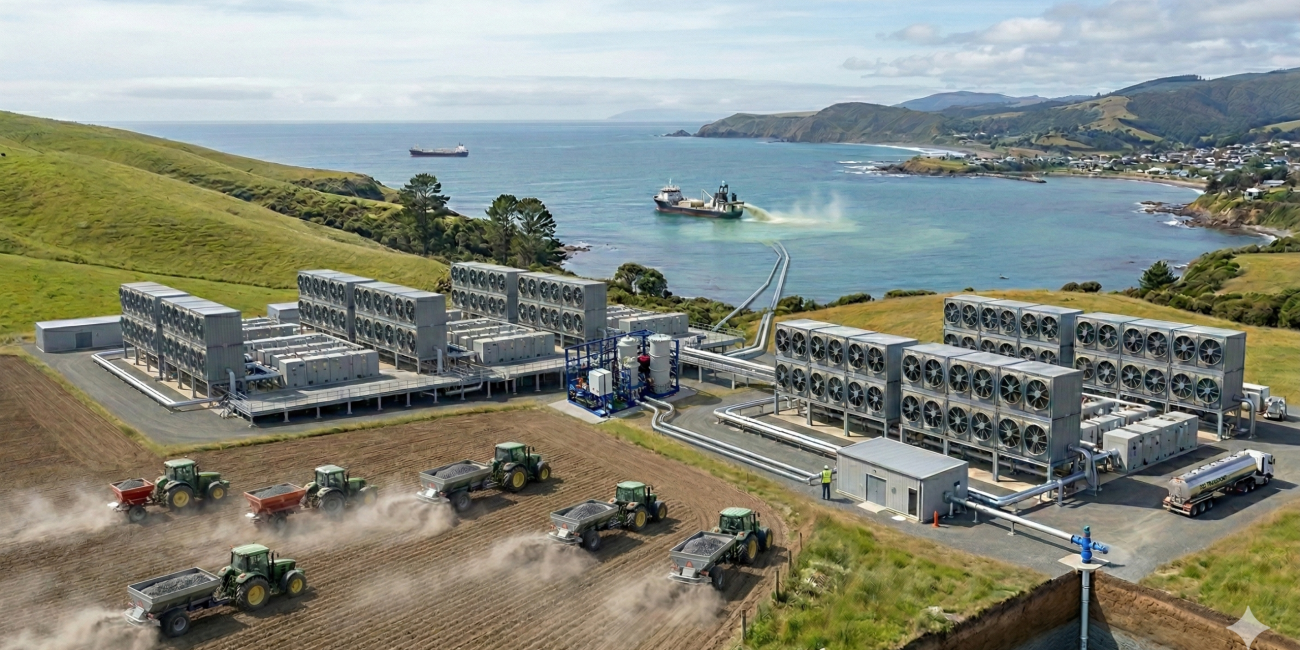
Several Direct Air Capture (DAC) technologies use alkaline materials like lime to capture CO2 from ambient air in controlled chemical looping systems, acting as an engineered acceleration of natural carbonation. For example, EcoLime-produced lime can be laid out in thin layers to ensure maximum air contact, and specialized methods enhance the reaction rate, turning a process that might naturally take years into one that achieves significant carbonation in just a few days.
Ocean Alkalinity Enhancement (OAE)
Lime can also be used as a key feedstock for enhancing the ocean’s natural capacity to absorb and store atmospheric CO₂. When alkalinity sources are added to seawater, the water’s alkalinity increases, which in turn causes the water to absorb more CO₂ from the atmosphere. This process, known as Ocean Alkalinity Enhancement (OAE), creates a chemical imbalance that shifts the dissolved carbon equilibrium away from carbonic acid (which causes acidification) toward stable bicarbonate and carbonate ions. This means the ocean can safely hold more carbon dioxide which prompts the ocean to draw down more CO₂ from the atmosphere, stably storing it for millennia. OAE has immense scale potential and can even mitigate the effects of ocean acidification on a local level. Using sustainable sources of alkalinity such as green lime here is essential, as its reduced carbon debt contributes to the overall carbon balance of the process.
Water Treatment
Similarly to its advantages in alkalinity enhancement, lime plays a critical role in sequestering carbon in water management processes, such as in drinking water softening and wastewater treatment. In water softening, lime is added and reacts with dissolved CO₂ to precipitate CaCO₃, achieving nearly 100% carbonation and capturing an equivalent amount of CO₂ to the process emissions that were released during conventional lime production. In municipal wastewater treatment, high-purity lime can be introduced to the biological treatment basins. Here, the added alkalinity reacts with the biogenic CO₂ generated by microbes, converting the carbonic acid into stable dissolved bicarbonate ions. As bicarbonate is a non-volatile ion, the CO2 is prevented from escaping back to the atmosphere during aeration and discharge; instead, it enters the marine carbonate system where it is durably stored for over 1,000 years.
Enhanced Rock Weathering (ERW)
Lime is also an effective feedstock for Enhanced Rock Weathering (ERW), a land-based CDR strategy that accelerates the natural geological process where alkaline minerals chemically bind atmospheric CO₂. Spreading lime on agricultural soils is a well-established practice to improve soil pH and health, and it simultaneously acts as a form of enhanced weathering. The use of lime in this manner leverages existing supply chains and agricultural infrastructure, providing dual benefits of environmental remediation and agricultural yield enhancement while ensuring permanent CO₂ storage in the soil.
Resolving the Paradox
As we can see, lime is currently a massive emitter, responsible for a huge percentage of atmospheric greenhouse gases, but thanks to its alkalinity, it’s also an essential substance in multiple high-potential CDR pathways. By producing lime in a decarbonized process, we can tap into its huge potential to rehabilitate our environment, and facilitate countless new ways to reduce global concentrations of atmospheric CO2.
To learn CarbonBlue’s EcoLime technology, click here.